Southwest Yard & Garden – Is There Anything Grasshoppers Won’t Eat?

Southwest Yard & Garden – Is There Anything Grasshoppers Won’t Eat?

Southwest Yard & Garden – Is There Anything Grasshoppers Won’t Eat?


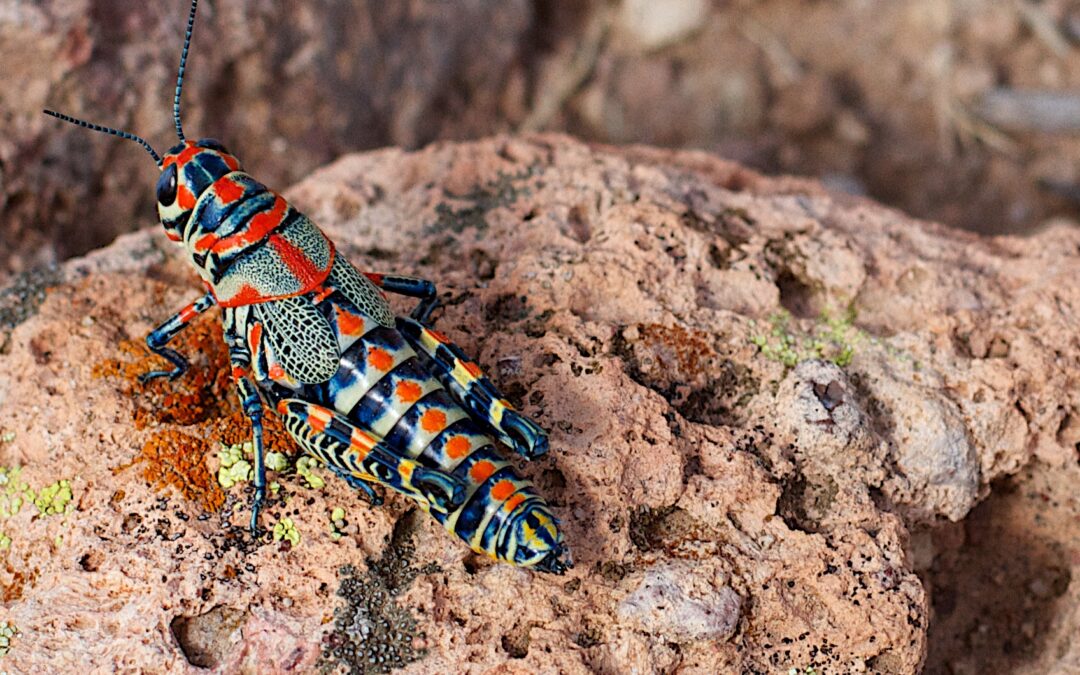
This colorful rainbow grasshopper (Dactylotum bicolor) can be easy to find in desert grassland areas, but is not considered to be an economically important pest in our region. Photo credit Alan Levine (Wikimedia Commons).

 A few people have recently reported what appears to be grasshopper damage on a variety of landscape and garden plants. The telltale signs are 1) ragged, chewed holes in leaves, stems, and fruit, and 2) droppings (aka frass, insect excrement) that look kind of like little black ants without legs. Please note that circular, smooth holes on the edges of leaves are more likely to have been made by leaf-cutter bees, and are a welcome sign in my garden!

“A Manual of the Grasshoppers of New Mexico” is a great NMSU online tool for all things grasshopper that includes ecology, economics, and a history of these interesting pests in New Mexico (https://aces.nmsu.edu/academics/hoppers). Also included are species descriptions, distribution maps, and photos.

For more links to helpful info on pesky and beneficial insects, visit the blog version of this column at https://nmsudesertblooms.blogspot.com/2021/06/hoppers.html.

 The following is a reprinted column by Dr. Curtis Smith from August 24, 2002.

https://aces.nmsu.edu/ces/yard/2002/082402.html

Question: I have always wondered about the grasshoppers that attack my garden most years. Is there anything I can plant that they won’t eat?

Answer: Dr. Carol Sutherland, NMSU Extension Entomologist [retired in 2021], told me that there is a grasshopper to eat any plant you may grow. Not all grasshoppers eat all plants; some are very specific, while others are not picky eaters at all.

She says that there are at least 160 described species in New Mexico (implying that there may be even others yet to be discovered and described). A couple of these prefer to eat weeds and could be considered beneficial. Of the remainder, about 40 species have the potential to become major pests. Some of these prefer grasses, others broadleaf plants, and some both. The extent of the problems we have in our landscapes depends on which species are present (usually more than one), how many of them are present, and what they prefer to eat. I find the following statement from Dr. Sutherland very informative. “Short of rebar, steel, aluminum, adobe, rock, asphalt, and concrete, I can’t think of many substances that will be little damaged consistently by grasshoppers of one kind or another.” So, in one year we may have fewer problems; in another year, we may have more problems.

Dr. Sutherland also explained that the weather affects the numbers of grasshoppers. Drought, especially in the early spring, can greatly reduce the grasshopper population, and thus the damage done by grasshoppers. When we irrigate, we help the grasshoppers avoid the spring drought dilemma. Careful and limited irrigation of landscapes may help, but the river valleys are also escape valves for grasshoppers. If they can make it to the valleys, they will survive and be able to migrate to our gardens.

There are chemicals to use, but their effect is limited by the fact that grasshoppers are migratory. Adult grasshoppers have wings and can fly into our gardens. So, after we kill some, new grasshoppers arrive to continue eating our garden plants. Some people prefer the insect diseases that can be purchased as biological control for grasshoppers. These are effective with some species, but not all species. Some gardeners claim great success using guinea fowl, turkeys, and other birds that eat grasshoppers. Unfortunately, some birds (biological grasshopper control agents) also eat garden plants.

Grasshoppers are a difficult problem for gardeners in our area. For the very adventurous gardeners, Dr. Sutherland states that grasshoppers are edible and highly nutritious. I think that is good information for the guinea fowl (I am not yet ready to eat grasshoppers).

Extra note from Marisa: A friend once made “hopper poppers” by stuffing jalapeños with grasshoppers and cheese before roasting them. If you try them, please post pics on social media and tag me (@NMDesertBlooms).


For more gardening information,
 visit the NMSU Extension Horticulture page at Desert Blooms and the NMSU Horticulture Publications page.  Find your local Cooperative Extension Office at https://aces.nmsu.edu/county/.

Dr. Marisa Y. Thompson, Ph.D., is the Extension Urban Horticulture Specialist in the Department of Extension Plant Sciences and is based at the New Mexico State University Agricultural Science Center at Los Lunas.

Southwest Yard & Garden –  Fun with Nectarine Sap Exudate

Southwest Yard & Garden – Fun with Nectarine Sap Exudate

Southwest Yard & Garden – Fun with Nectarine Sap Exudate


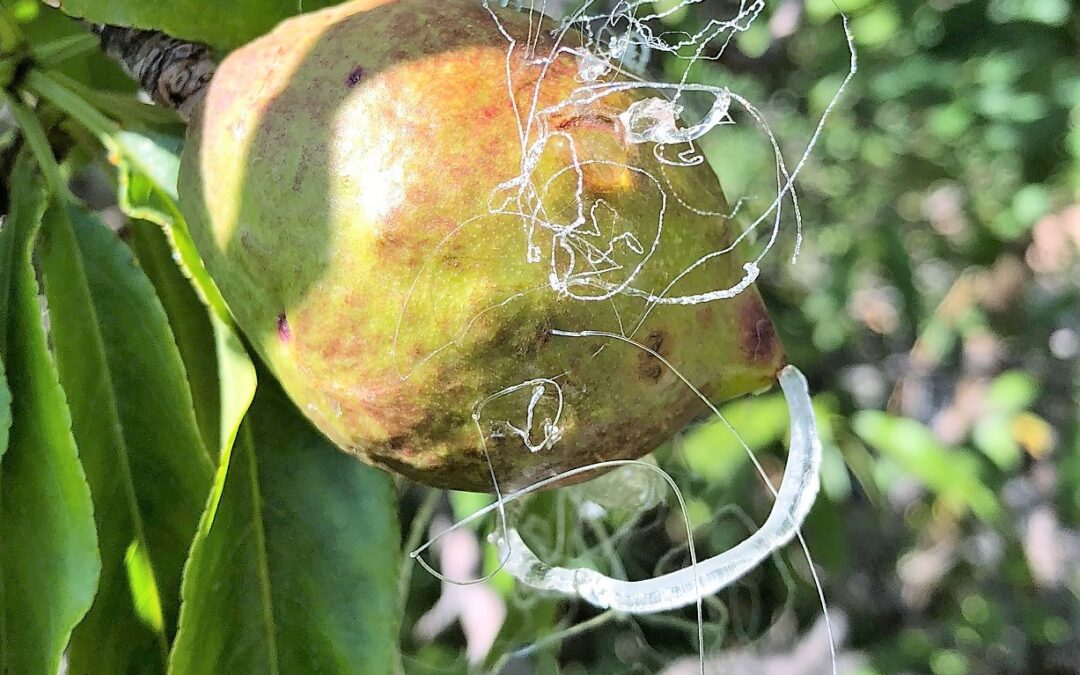
Nectarine Sap Exudate from Tiny Holes in Peel Created Bizarre Formation: Osmotic Pressure Inside Nectarines Forced Sap to Ooze Delicately

 Question: What’s the deal with these clear, stiff, noodle-like formations on my nectarines? Have you ever seen anything like this?

–  A. Arber, Albuquerque, NM

    • Figure 1. Sap exudate oozing out of these nectarines was whipped around by the wind before it had a chance to dry and solidify, making extremely rare decorative formations (photo credits A. Arber).

 Answer: Wow, I have never seen anything like this before! I shared your strange photos with several experts from around the state. All agree that the images show extremely rare, spiraling strands of hardened nectarine sap, but there’s no real cause for alarm or recommended action.

Figure 2. Sap exudate along wounded portion of immature nectarine in Albuquerque (photo credit S. Moran

NMSU Bernalillo County Extension Horticulture Agent, Sara Moran, suggested that a species of thrips—or other insects with tiny, rasping,sucking mouthparts—punctured the firm fruit skin, and the internal pressure caused sap to exude. She shared a photo (Fig. 2) of another nectarine in Albuquerque with little short noodles of sap exudate.

Thrips (the correct spelling for both the plural and singular forms) are common, tiny, fringe-winged insects that can be either beneficial when they prey on other pests or harmful when they make mini cat scratch marks on leaves and flowers of various species. They can also be a vector for tomato spotted wilt virus. If you’d like to see live thrips, here’s what you do: walk up to a yucca plant with flowers and shake the flower stalk over a piece of paper or your hand. At first, you might only see other bigger bugs, but look closely and I’ll bet you will see the slender, yellowish thrips running around. They are less than 2 millimeters in length (about 8/100 inch). I did this here at the NMSU Agricultural Science Center in Los Lunas and videoed it (https://nmsudesertblooms.blogspot.com/). Warning: don’t do what I did and get so close to the yucca leaf tips that they poke your finger and make you bleed.

Other possible causes for the nectarine art form were described by Dr. Curtis Smith, my predecessor: “I’m going to guess that we are seeing the combined results of mechanical injury and internal osmotic pressure. Prunus species (i.e., stone fruits, including nectarines, plums, cherries, peaches, and almonds) will especially show jelly-like sap exudation after an injury when the flow of sugary sap meets an obstruction and then finds a hole or crack through which the sap can exude. Hail damage, wind damage, even skin damaged from earlier insect feeding can become rigid and unable to stretch. When water is absorbed, the skin can crack or otherwise form an opening through which the sap can ooze. Wind may be a factor in the fanciful patterns seen in the photographs.”

Hail reports on the Community Collaborative Rain, Hail & Snow Network (CoCoRaHS; https://www.cocorahs.org/ViewData/ListHailReports.aspx) for Bernalillo County highlight two recent hail storms, one on May 21 and one on June 3 of this year.

I Googled intensely for similar images but could not find any resembling this kind of intricate sap pattern. I did learn that “gummosis” is common on tree trunks and can be a sign of a bacterial infection, other disease, or insect wound, and in some plant species is completely normal. California almond growers battle with a pathogenic form that infects the fuzzy fruit called bacterial shot hole.

2021 UPDATE: After writing that column in June 2018, I imagined that the clear, hardened sap might taste like candy. So upon getting back to the client, I asked if he’d try it. He reported back that it had no particular flavor, which actually makes more sense this early in the season before the fruit ripen and get sweet.

I’ve received several photos of hardened gummosis on nectarines and plums in the past month, although none as whimsical as the delicate exudate structures protruding from the nectarines in 2018. Maybe this is the price we pay in years when we don’t lose our fruit crops to late freezes or hail storms.

It’s time to thin fruit on trees that have a heavy load anyways. And purging the gummy ones is a good way to start. I know it’s emotionally hard to do, but getting rid of these uglier fruits allows the sugars they would have gotten to be sent to other fruit. Even under the best circumstances, damaged fruit often have trouble fully ripening. Thinning before other fruit mature helps the survivors get those sugars and other goodies. For more on the importance of fruit thinning, visit Thinning Fruit for Tree Health (Desert Blooms).

For more information on garden insects and diseases, check out these NMSU Cooperative Extension Service publications:

“Integrated Pest Management (IPM) Strategies for Common Insect Pests of Trees in New Mexico” Guide H-174

“Guide to the Biological Control of Some Common Yard and Garden Pest Insects in New Mexico” Circular 607

“Thrips” Guide O-09

“Pocket Guide to the Beneficial Insects of New Mexico”

For more gardening information, visit the NMSU Extension Horticulture page at Desert Blooms and the NMSU Horticulture Publications page.  Find your local Cooperative Extension Office at https://aces.nmsu.edu/county/.

Dr. Marisa Y. Thompson, Ph.D., is the Extension Urban Horticulture Specialist in the Department of Extension Plant Sciences and is based at the New Mexico State University Agricultural Science Center at Los Lunas.

Southwest Yard & Garden –  Heat-Loving Flowers for Color All Summer

Southwest Yard & Garden – Heat-Loving Flowers for Color All Summer

Southwest Yard & Garden – Heat-Loving Flowers for Color All Summer


Question: I want to try growing flowers from seed in my front yard. Which do you recommend I start with first?

  • Sylvia S. (age 10), Las Cruces

Answer: I’ve had great luck growing flowers from seed, and I think you will too. I try different combinations each year and usually forget the ones that didn’t ever come up. One tip is to get a mix of wildflower seeds the first year, pay attention to the ones that flower and thrive in your particular environment, and then buy more of those in future years. To save you the trouble, here are a few that have worked well for me: rocket larkspur, cosmos, sunflowers, blue flax, Rocky Mountain beeplant, zinnias, and sacred datura.

The trick is that they do need some moisture to get growing and keep looking good, especially in bad monsoon years (aka mon-later or, worse, mon-never). Spread flower seed around in places that are already getting watered, like within and around vegetable beds, around trees and shrubs, and at the base of vines and ornamental grasses. If you have a soaker hose, you can lay it out (straight, curved, or looped) in the desired spot and plant your seeds along the hose, so you know they’ll benefit.

For a meadowy look, add native grass seed in with the mix and water them with a soaker hose or sprinkler in the evenings about every 3rd or 4th day (check the soil occasionally and adjust if it gets bone dry sooner or if moisture holds longer). My favorite grasses are blue grama, sand lovegrass, and sideoats grama.

The sunflower is another tried and true winner for gardeners—and wildlife too. Don’t get too stressed when you see various bugs all over the lower leaves. Pests that thrive on your sunflowers are great at attracting beneficial insects and birds. Check out my blog for a link to an older column titled, “Sunflowers are Loved by Many” and other resources on attracting beneficial insects.

Sunflowers can grow from seed to full flower in as little as 70 days, depending on the variety. This is both good and bad, as spent sunflowers are a pitiful sight. Beat the “bloom and bust cycle” by staggering your plantings a few weeks apart. Try a handful of seeds once or twice a month through the summer. You’ll be glad you did, and the birds will be too.

In an archived Southwest Yard & Garden column from 2001, Dr. Curtis Smith suggested, “For drier parts of the garden, plant Rocky Mountain zinnia and desert marigold. Cosmos takes a little more water as do the biennial hollyhocks. Sunflowers, rudbeckias (gloriosa daisy and black-eyed Susan), Shasta daisy, and many others do well in New Mexico.”

Desert marigold seedling with tiny, fuzzy, blue-ish leaves at Elephant Butte Lake, February 2020 (left); mature flower stalks in a new development off Hwy-10 in Las Cruces, October 2020 (middle); and a sunny flower head soaking up the sun in Los Lunas, August 2017 (right). Photo credits M. Thompson.

I was excited, but not surprised, to see Dr. Smith recommend my favorite New Mexico wildflower, desert marigold (Baileya multiradiata). In warmer regions, these beauties can grow as perennials, and up north they’re usually annuals that grow from seed each year. As a tiny sprout, the fuzzy leaves have an almost blue hue. Later in the season, the bright yellow flowers can be found on disturbed roadsides, desert trails, lakesides, and, hopefully, in my front yard by the end of this summer.

As well as growing them from seed, annual flowers can also be purchased from local garden centers as small plants and transplanted in your garden or patio containers. I’m always on the lookout for 4- and 6-packs of prairie verbena (Glandularia bipinnatifida, aka Verbena bipinnatifida, fern verbena). If you find them, please let me know where, get a few for yourself, and leave some for me!

For more gardening information, visit the NMSU Extension Horticulture page at Desert Blooms and the Cooperative Extension Publications page.  Find your local Cooperative Extension Office athttps://extension.nmsu.edu/county.html.

Dr. Marisa Y. Thompson, Ph.D., is the Extension Urban Horticulture Specialist in the Department of Extension Plant Sciences and is based at the New Mexico State University Agricultural Science Center at Los Lunas.

Southwest Yard & Garden –  Hummingbirds are BACK

Southwest Yard & Garden – Hummingbirds are BACK

Southwest Yard & Garden – Hummingbirds are BACK

This week, in honor of the golden currant (Ribes aureum) shrubs blooming in the Los Lunas bosque and at the City of Albuquerque BioPark Botanical Garden, I’m writing about hummingbirds in the garden. I learned from a local birder (I wish I could remember who it was!) that you know it’s time to put out your hummingbird feeders when the golden currants are in bloom.

Golden currants (Ribes aureum) in bloom in the Los Lunas bosque on April 7, 2019 (left), March 25, 2020 (middle), and April 5, 2021 (right). Photo credits Marisa Thompson.

If you’re curious about creating a hummingbird haven in your yard, the book Hummingbird Plants of the Southwest by local author Marcy Scott is a great place to start. On top of excellent details on 120 hummingbird plants for gardens in our region, Scott profiles the 14 hummingbird species found in the Southwest. She also provides precise information on how to create prime hummingbird habitats. “For beginners especially, penstemons are great starter plants for the hummingbird garden and, given a mostly sunny spot and good drainage, they are easily grown most anywhere in the Southwest.” The trick is selecting a mix of flowering plants so that your garden offers nectar throughout the growing season. Scott includes 21 different penstemon species in her book along with their blooming periods. And while red flowers are famously attractive to hummingbirds, “The quintessential hummingbird flower, in summary, will usually be red, reddish-pink, orange, or yellow (and yes, there exist a number of blue, purple, and even white exceptions to this rule).

Last summer, I counted as many as six hummingbirds at once, buzzing between three feeders in my backyard. Even if you’ve only seen one hummingbird at a time, I’ve got great news for you. As David Allen Sibley writes in his new book What It’s Like to Be a Bird, “A rough rule of thumb for estimating the total number of hummingbirds using your feeder is to count the most birds you see at one time and multiply by ten.” Having multiple flowering plants and feeders around your yard can also help avoid having one dominant bird who chases others away. Sibley adds, “A typical individual visits the feeder about once every thirty minutes, and in between it will be catching insects (which can constitute up to 60 percent of its diet) and visiting flowers.

For hummingbird feeders, I found the following recommendations in a 1999 Southwest Yard & Garden column by my predecessor Dr. Curtis Smith that includes tips from Dr. Jon Boren, then NMSU Extension Wildlife Specialist and current Associate Dean and Director of New Mexico’s Cooperative Extension Service:

  •    To make your own artificial nectar solution, mix 1 cup of plain white sugar (not honey) in 4 cups of water.
  •    Red food coloring is unnecessary and may be unhealthy for the birds.
  •    Red decor on the feeder helps grab hummingbirds’ attention.
  • Clean feeders thoroughly with a solution of 1 tablespoon of white vinegar added to 1 cup of water every 2–3 days when the weather is warm.

Sitting pretty outside my office window. Photo credit M. Thompson.

Dr. Boren also suggested getting feeders with a perch to encourage the birds to feed for longer periods of time. An added bonus of the perch is that these busybodies are way easier to photograph when they’re sitting.

Looking for a great gift for Mother’s Day or Father’s Day this year? How about a hummingbird habitat starter kit that includes a few native flowering plants, a feeder, and a birding book? I hope my parents don’t read this column! (Just kidding, they both help edit it every week!)

Black chinned hummingbird nest on my holiday lights in May 2020. Photo credits M. Thompson

Hummingbird resting on a spent sunflower stem on September 14, 2020. Photo credit M. Thompson.

For more gardening information, visit the NMSU Extension Horticulture page at Desert Blooms (http://desertblooms.nmsu.edu/) and the NMSU Horticulture Publications page at http://aces.nmsu.edu/pubs/_h/.  Find your local Cooperative Extension Office at https://aces.nmsu.edu/county/.

Dr. Marisa Y. Thompson, Ph.D., is the Extension Urban Horticulture Specialist in the Department of Extension Plant Sciences and is based at the New Mexico State University Agricultural Science Center at Los Lunas.

Southwest Yard & Garden –  Diagnosing Trees with Oozing Sap… Again

Southwest Yard & Garden – Diagnosing Trees with Oozing Sap… Again

Southwest Yard & Garden – Diagnosing Trees with Oozing Sap… Again

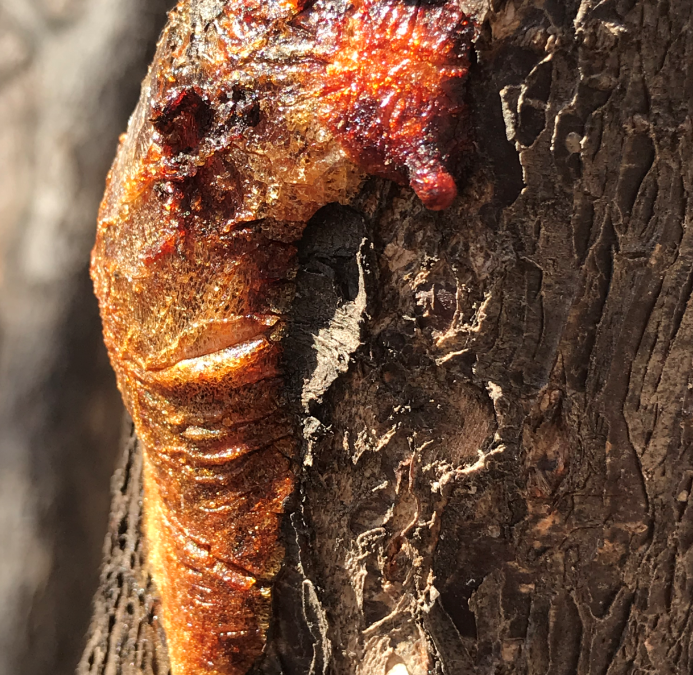
Reddish sap oozing from a plum tree at Bachechi Open Space in Albuquerque, March 2021. Photo credit M. Rehn.

(but this time, the sap is reddish-orange and doesn’t stink!)

Question: Any idea what may be causing the sap to run out of some of these plum trees in the arboretum at Bachechi Open Space?

–          Dustin C., Albuquerque

Answer: This is turning out to be another one of those common questions that come in from all parts of the state. In the past two weeks, I’ve gotten photos of orange or red sap oozing from plum trees and a redbud in the Albuquerque area, an ash in Las Cruces, and I’ve taken a ton of pictures of plum, cherry, and peach trees with similar globs that have hardened after a few years in the sun. Are these weird amber blobs caused by borers or a plant pathogen? Or both? How do you tell? And what can be done about either?

We learned about the peach tree borer back in March 2018:

The greater peach tree borer (Synanthedon exitiosa) is known for causing oozing trunk wounds found at ground level or just below the soil line on stone fruit trees. The sap is often clear, but sawdust frass produced by the borer can be mixed in, giving it a darker color. Stone fruits are named for the pit, or “stone,” that encloses the seed; they include peaches, nectarines, plums, cherries, almonds, and others…

Besides a late freeze, the peach tree borer (also spelled peachtree borer) is the worst threat to stone fruits in New Mexico. Dr. Carol Sutherland, NMSU Extension Entomology Specialist and NMDA Entomologist [recently retired—CONGRATULATIONS!], says peach tree owners need to be aware that “everybody will have peach tree borer sooner or later, and if you do nothing it will kill your tree.”

Plant stress can be an invitation to pests, which are more likely to attack when the immune systems are weak…

Now let’s learn about cytospora canker, a fungal pathogen that is frequently found in New Mexico in woody tissue in poplars, willows, fruit trees, and many others. I reached out for help understanding cytospora vs. borer symptoms.

Phillip Lujan, Diagnostician for NMSU’s Plant Diagnostic Clinic (https://plantclinic.nmsu.edu), pointed out that it’s sometimes hard to distinguish between cytospora canker and borer damage without checking closely for borer holes. And it very well could be a combination of both. Lujan expressed concern that already this season, the NMSU Plant Diagnostic Clinic has received samples and photos of stressed trees. He adds that the prevalence of ooze in late winter and early spring is likely related to the trees starting to emerge from dormancy; as trees bud out and the sap starts moving again, they may be oozing more than at other times of the year.

Cytospora canker sap leaking from the bark of an ash tree in Las Cruces, March 2021. Photo credits P. Lujan.

Last summer, Lujan diagnosed cytospora canker in aspens in Albuquerque and Angel Fire and in cottonwoods in Socorro and Roswell. “This fungus is a relatively weak pathogen, which typically attacks stressed trees. Some symptoms of infection include circular, elongated, or irregular-shaped cankers, which first appear on infected trees as brown, slightly sunken areas in the bark of branches and trunks. As the canker enlarges, the outer bark may become black, brown, gray, reddish-brown, or yellow. The inner bark turns reddish-brown to black. The best management is to prevent infection by keeping trees from becoming stressed. Maintain good watering practices and prune out injured branches as they occur. On infected trees, remove all dead and dying branches. Do not prune trees when the bark is wet. There are no fungicides currently available for controlling cytospora, but again, this is a relatively weak pathogen.”

This bears repeating: As with many insect problems, trees that are already stressed are more likely to have problems with cytospora canker and other pathogens. Trees exhibiting cytospora canker symptoms, like the reddish ooze on tree trunks in these photos, may continue to live and even thrive, providing fruit and shade for many years, as long as the underlying stressors are alleviated. These are most commonly root restrictions (including girdling roots and compacted soils) and drought stress.

Last summer, I missed the chance to write about cytospora ooze and instead focused on slimeflux, a stinkier, but no less prevalent, tree trunk problem. For more on slimeflux, peach tree borers, and links to more amazing cytospora photos and info, visit the blog version of this column. I’ve also linked a fun video that starts with beautiful fruit tree flower buds and ends with me using my thumb to scrape a dried clump of orange sap from the bark of a cherry tree to look for borer hole evidence underneath.

Oozing sap on an aspen tree diagnosed with cytospora canker in Sandia Park, May 2020. Photo credit J. Smith.

For more gardening information, visit the NMSU Extension Horticulture page at Desert Blooms (http://desertblooms.nmsu.edu/) and the NMSU Horticulture Publications page at http://aces.nmsu.edu/pubs/_h/.  Find your local Cooperative Extension Office at https://aces.nmsu.edu/county/.

Dr. Marisa Y. Thompson, Ph.D., is the Extension Urban Horticulture Specialist in the Department of Extension Plant Sciences and is based at the New Mexico State University Agricultural Science Center at Los Lunas.

NMSU Hires State Manager for Master Gardeners Program

NMSU Hires State Manager for Master Gardeners Program

NMSU Hires State Manager for Master Gardeners Program

New Mexico State University’s College of Agricultural, Consumer and Environmental Sciences has hired a state manager for the Master Gardeners program. Eduardo Servin will be charged with overseeing Cooperative Extension Service specialists and growing the Master Gardener program across all 33 counties in New Mexico.

Read More about Eduardo here.