Bethany Abrahamson: Weeds! How to Catch Them When They’re Small🌱
Seed2Need[1] has encountered a parasitic weed killing the garden’s tomato plants. The weed was identified as a species of Broomrape – most likely Desert Broomrape – with the help of the Agricultural Extension Service at NMSU. The only crop vegetable this parasitic plant is known to kill is tomato.
Broomrape (Orobanche spp.) is a purple-flowered plant categorized as a noxious weed by the USDA. Broomrape attaches itself to the roots of tomato plants, eventually killing the host plant by depriving it of nutrients.
A single broomrape seedling quickly grows beneath the tomato plant, producing up to 500,000 microscopic wind-dispersed seeds that can survive in soil 35 years.
Every tomato plant in our large Seed2Need garden was affected in July. We believe that broomrape arrived in the garden in 2022, subsequently producing seeds that were tilled into the soil in the early spring of 2023. Measures are being taken to kill every broomrape and tomato plant in the affected patch.
We are sharing this information because broomrape may be growing in other tomato patches. If you find broomrape in your tomato patch, please report it to the Master Gardeners helpline at emailhelpline@sandovalmastergardeners.org
[1] Seed to Need is a nonprofit collaborative effort between the Sandoval Extension Master Gardeners, property owners in the village of Corrales and other volunteer groups, whose mission is to reduce hunger in the community by growing fresh fruits and vegetables and donating it to food pantries in Bernalillo and Sandoval Counties.
For more information, see the following articles:
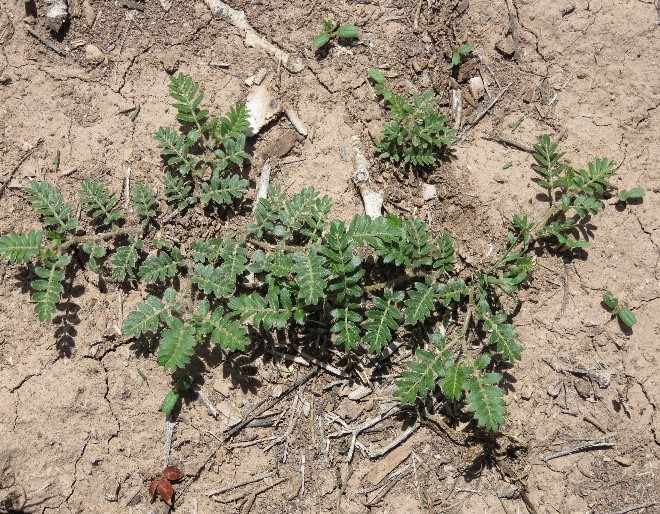
If you are new to gardening in New Mexico, you may not be familiar with the puncture vine, but once you step on one, you will become acquainted with this invasive weed very quickly. They are built to survive in an arid climate, and the seeds may last upward of twenty years, just waiting for the right climate in which to sprout. They are called goat heads because the fruit resembles the head of a goat or a bull. The fruits break up into several sections with very sharp barbs that stick to shoes, tires, and pets’ feet. They are very painful when stepped on. My first encounter with the weeds was shortly after we moved here and we decided to take a walk on a levee along the Rio Grande. When we returned to our car, the soles of our shoes were full of the spikes. I was finally able to get them out of my shoes, but my wife threw her shoes away because the spikes were embedded so deeply that they could not be removed. If you are not familiar with the plants, it’s best to go to the Internet, such as (http://ipm.ucanr.edu/PMG/PESTNOTES/pn74128.html) for a fuller description, and to see pictures; but here is a brief summary of what to look for. The plants are prostrate with
hairy stems that branch from the crown, and the leaves are opposite and pinnately compound to 1/8 inch long The flowers are yellow and about 6mm wide. Plant size varies. They may be a few inches wide as the vines trail out from the root, or they may reach several feet under the right conditions. They usually grow in barren or disturbed locations such as construction areas, parking lots, driveways, and vacant land, as they do not compete well with other plants. They are annuals, and will die with the first frost, but will leave behind seeds that may remain dormant for several years. Because it may take only a few weeks for new plants to sprout from some of the seeds, it is important to remove the plants and any fruit quickly when discovered. I favor physical removal because chemical treatment may leave the seeds behind.The only known way to destroy the seeds is fire. A propane torch will work well on a driveway or vacant lot, but if the goat heads are growing among other plants, they will go up in smoke also. You definitely do not want to put goat heads in your compost bin, because some of the seeds may survive the composting process. Chemical treatment will at least take care of the existing weeds, but the seeds will remain.
by David Pojmann
By Penny Davis, SCMG
“Gardening is something you learn by doing and by making mistakes. Like cooking, gardening is a constant process of experimentation, repeating the successes and throwing out the failures” Carol Stocker
Over the next two months, I would like to share some of the lessons learned from the Seed2Need project. I hope you will find this information useful and that it will encourage you to share some of your own experiences so we can learn from one another.
http://today.agrilife.org/2010/12/22/root-knot-nematode/
Internet research led us to a study at Iowa State University that found corn gluten to be 87-99% effective in controlling broad leaf weeds. Corn gluten also adds 10% nitrogen to the soil. We found 40# bags of corn gluten at a local nursery and sprinkled it around the tomato seedlings as they were planted. When the tomato plants were uncovered in July, we found very little pigweed.
For more information on this study see
http://www.hort.iastate.edu/wp-content/uploads/2014/12/grnhsechr.pdf
http://www.ces.ncsu.edu/fletcher/programs/ncorganic/special-pubs/herbicide_carryover.pdf
I find this problem particularly disturbing since this herbicide can remain active for 2 years and can show up in compost as well as in many types of manure.
An article published by Clemson University reported that spreading activated charcoal on a contaminated field in will deactivate the herbicide.
http://www.clemson.edu/extension/horticulture/turf/pest_guidelines/pesticide_deactivation.html
This spring (2015), we plan to treat this garden with activated charcoal. We will let you know the results this summer.
Over the years we have tried a variety of ways to control squash bugs, e.g. pesticide, examining every leaf, killing the squash bugs and smashing their clusters of eggs, planting companion plants that are purported to repel squash bugs, torching the squash bugs when the infestation gets out of hand and trap cropping (planting a crop that attracts the squash bugs to encourage them to stay away from the other cucurbit crops). So far, the score is Squash Bugs 5, Seed2Need 0. Nothing we have tried has been effective.
In 2015, we will plant all cucurbit crops under row cover and leave them covered until mid summer. We will also start a trap crop of Blue Hubbard squash under row cover. In addition, at the end of the 2014 garden season, we hauled most of our tomato vines to the Sandoval County Landfill rather than composting them so we didn’t leave a pile of vines to serve as cover for over-wintering squash bugs.
One side note…When we removed the row cover from the cucurbit crops in early August, we assumed that there would be no fruit because the pollinators could not reach the flowers. However, there was fruit. Our best guess is that the ants served as our pollinators. For an interesting article on ants as pollinators see
http://pollinators.blogspot.com/2012/10/ants-unlikely-pollinators.html
Coming up in Part II: blossom end rot, tomato cages, row cover and plastic mulch.